
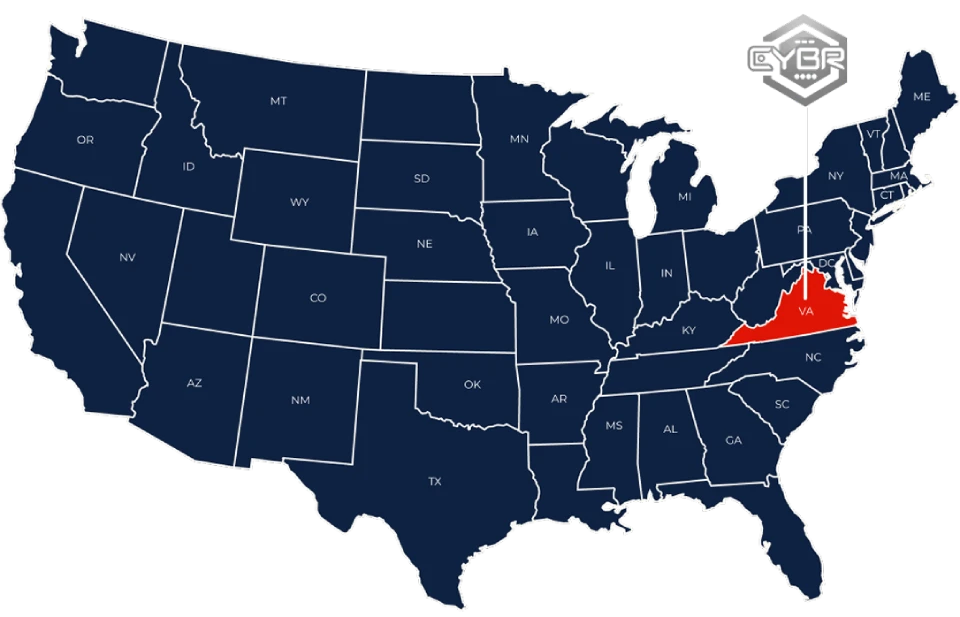
Proudly Serving the United States

_Stacked.svg.webp)
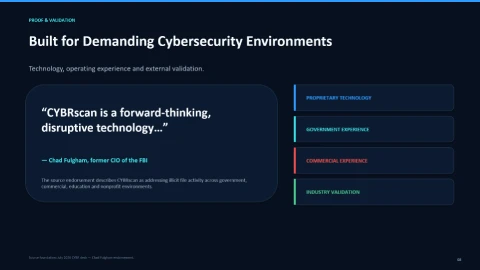
“This specialized threat and assessment solution is a must-have for any government, commercial, education and non-profit."
— Chad Fulgham, former CIO, Federal Bureau of Investigation
Attacks Have Evolved. Security Tools Haven’t.
1. Every large organization sits on a haystack.
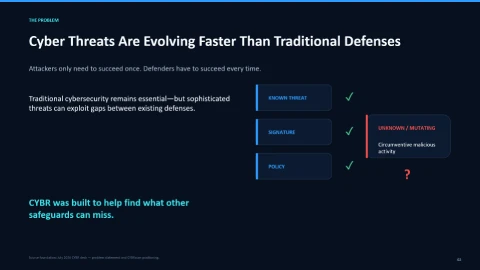
Millions of files, logins, and events a day. Almost all of it is harmless. But somewhere inside lies the threat. Security software used to detect these threats by working like a bouncer with a book of mugshots, checking files against a list of known threats and turning away anything that matched.
2. But today's attacks are more sophisticated.
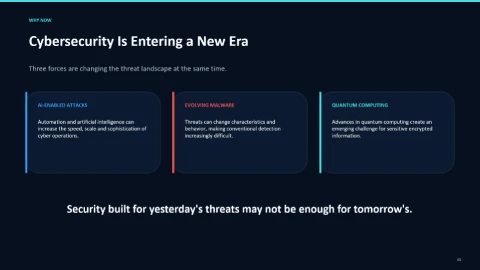
Some malware even rewrites itself so it never looks the same twice. And, increasingly, there is no file to check at all. According to CrowdStrike's 2026 report1, 82% of detections involved no malware file at all. With nothing to match, there’s nothing for legacy tools to stop.
3. And the haystack now includes things you can touch.
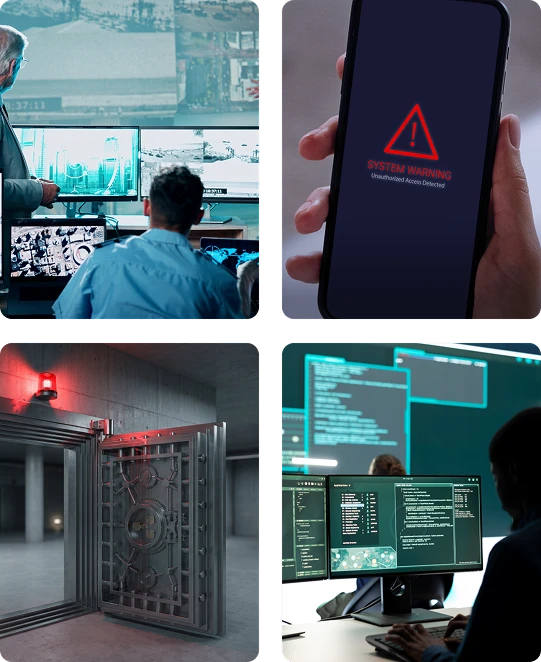
A drone over a substation. A badge that lets in the wrong person. A piece of code that unlocks a door. Attackers hit the network and the building in the same campaign, because to them it was always one job.
4. This is not theoretical.
In a coordinated campaign documented by the US Cybersecurity and Infrastructure Security Agency, attackers disrupted community water systems across multiple states. Operators were locked out of their own equipment, and some plants went back to running manually, while residents were told to boil their water to remain safe.
Finding the Threat Needle in the Cyber Haystack
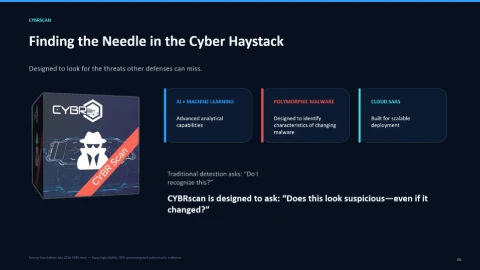
Our flagship product, CYBRscan, studies how a file behaves instead of what it matches. Where traditional antivirus asks "Is this exactly a threat I already know?", CYBRscan asks "Does this look like trouble?".
It scores how suspicious something is rather than demanding a perfect match, which is how it catches malware nobody has seen before. This is our own code, on infrastructure we own, held as a trade secret.
When Detection Fails, the Cost Is Measured in Lives, Not Data.
When ransomware hits a hospital, patients already admitted die at rates 34% to 38% higher than they otherwise would, according to a February 2026 study in the American Economic Journal: Economic Policy linking Medicare claims to confirmed ransomware attacks.2
What We Sell Today

CYBRscan

Professional Services

Operational Security
Five More Tools, Running Live Demos Today
Where We’re Headed
Planned, not yet operating. We bought a 30-acre Virginia property in 2025 and plan to build a proving ground where cyber and physical security are trained and tested together: a security operations center, a cyber-physical lab, and test ranges for autonomous systems.
We are also exploring rewards for threat intelligence contributed through the platform. That work is in planning with no timeline set.
What is live today is a profitable, credentialed company already delivering.
The Old Rules No Longer Apply
Three forces are converging at once. The old security stack wasn't built for any of them.
Real Revenue. Real Contracts. Real Credentials.
Other early-stage cybersecurity companies ask you to invest in an idea. We are an operating business with a federal contracting record.



Security Spending is Racing Toward $430 Billion by 20294
AI-driven threat detection is projected to roughly double from ~$25.5 billion in 2026 to $50.8 billion by 2031.5
But the real opportunity is bigger than any single category. Threats no longer respect the line between digital and physical. A compromised drone, a spoofed access badge, a piece of malware that opens a door: these are the same fight now. CYBR is built for that convergence.
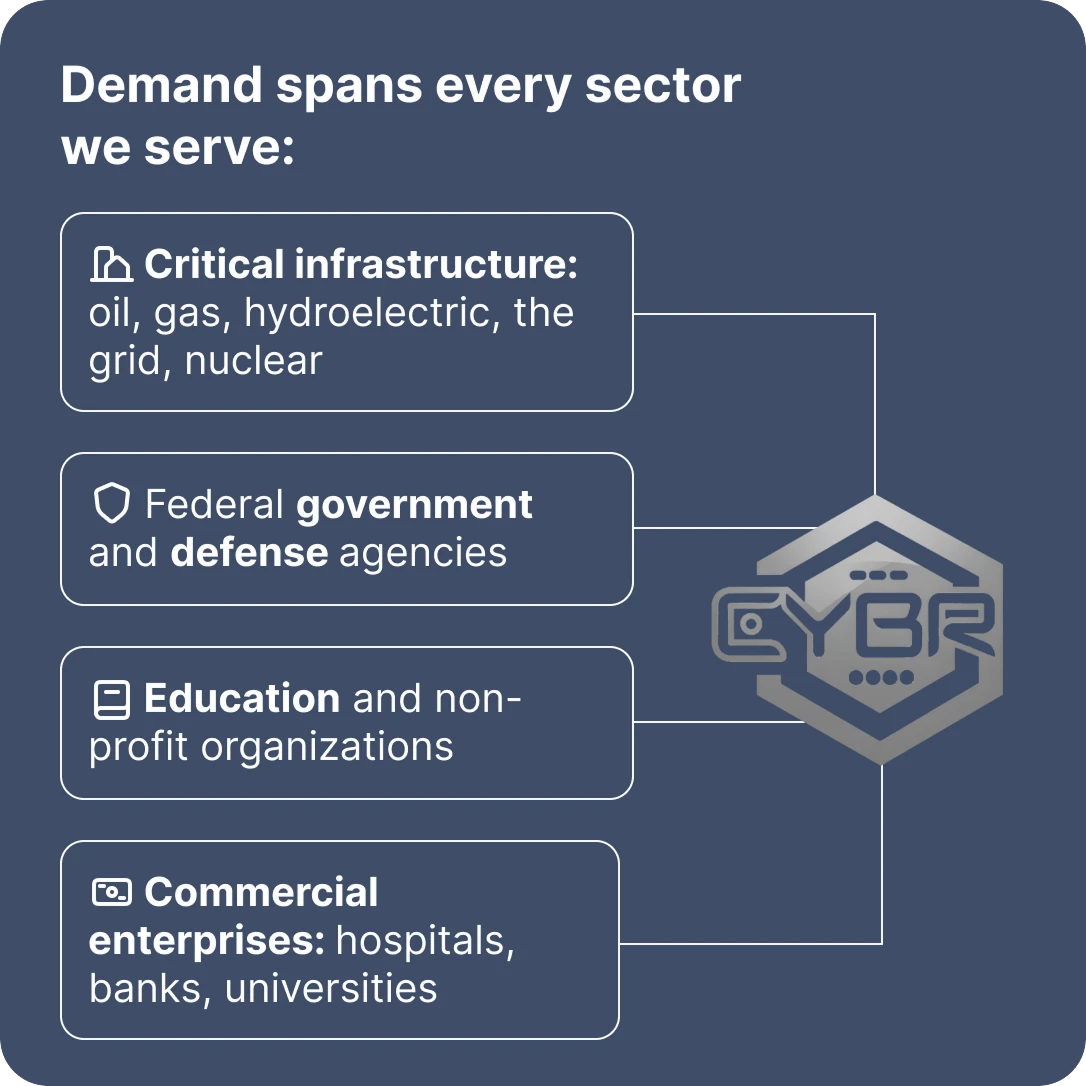
Demand spans every sector we serve:
- Federal government and defense agencies
- Critical infrastructure: oil, gas, hydroelectric, the grid, nuclear
- Commercial enterprises: hospitals, banks, universities
- Education and non-profit organizations
Three Revenue Streams, Behind a Door Most Competitors Can’t Open
Selling to the federal government requires credentials that take years and real money to earn. Between proven technical ability, a clean performance record, and government clearance, most commercial vendors are unable to place a bid. We are.
Cloud Software (SaaS) — Recurring subscriptions. Enterprise contracts run $250,000+ per year each, and they renew.
Professional Services — Billed expertise, embedded in customer environments.
Federal Contracts — Sold through the GSA Multiple Award Schedule, where federal buyers spent $1.8 billion in FY20256 in the Security and Protection category. Our credentials are the ticket to compete for that work, and our HUBZone status makes us eligible for up to $25M a year in set-aside contracts.
We Have More Demand Than We Have People
Why raise money if we're already profitable? Profit at our current size funds the team we have. It does not fund the sales force the pipeline in front of us requires. Eighteen people built a profitable, federally credentialed company. That same eighteen people are now the ceiling.
We intend to use the net proceeds of this Offering as follows:
Built by Operators From the Highest Levels of U.S. Security

Shawn R. Key
Founder, CEO & President
• Mentored by Richard Marcinko, founder of SEAL Team 6 — the root of CYBR's blended physical-and-cyber approach;
• Named an "ethical hacker" in a 1999 Government Executive feature; backed by MACH37, the Dell Founders 50 Club, and Tandem NSI (an NSA affiliate).
Joseph W. Steen
Director & Intelligence Community Expert
• Managed a division of 600+ personnel and helped launch the CIA's applied-research work with DARPA, IARPA, and In-Q-Tel;
• Served as Senior Duty Officer in the CIA Operations Center during the opening of the Iraq War, moving intelligence to the President and top policymakers.
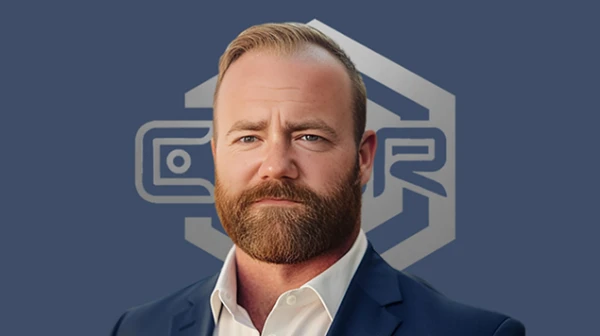
John Wilson Cochran
Co-Founder & VP, Business Development
• Structures CYBR's contracts and investment base;
• Co-won the 2014 NVTC Destination Innovation Award (Security) alongside Shawn for CyberMerlin, CYBR's original detection software.
Turn Your Investment into More Shares
Frequently Asked Questions
Why invest in startups?
Regulation CF allows investors to invest in startups and early-growth companies. This is different from helping a company raise money on Kickstarter; with Regulation CF Offerings, you aren't buying products or merchandise - you are buying a piece of a company and helping it grow.
How much can I invest?
Accredited investors can invest as much as they want. But if you are NOT an accredited investor, your investment limit depends on either your annual income or net worth, whichever is greater. If the number is less than $124,000, you can only invest 5% of it. If both are greater than $124,000 then your investment limit is 10%.
How do I calculate my net worth?
To calculate your net worth, just add up all of your assets and subtract all of your liabilities (excluding the value of the person's primary residence). The resulting sum is your net worth.
What are the tax implications of an equity crowdfunding investment?
We cannot give tax advice, and we encourage you to talk with your accountant or tax advisor before making an investment.
Who can invest in a Regulation CF Offering?
Individuals over 18 years of age can invest.
What do I need to know about early-stage investing? Are these investments risky?
There will always be some risk involved when investing in a startup or small business. And the earlier you get in the more risk that is usually present. If a young company goes out of business, your ownership interest could lose all value. You may have limited voting power to direct the company due to dilution over time. You may also have to wait about five to seven years (if ever) for an exit via acquisition, IPO, etc.
Because early-stage companies are still in the process of perfecting their products, services, and business model, nothing is guaranteed. That's why startups should only be part of a more balanced, overall investment portfolio.
When will I get my investment back?
The Common Stock (the "Shares") of CYBR International (the "Company") are not publicly-traded. As a result, the shares cannot be easily traded or sold. As an investor in a private company, you typically look to receive a return on your investment under the following scenarios:
- The Company gets acquired by another company.
- The Company goes public (makes an initial public offering).
In those instances, you receive your pro-rata share of the distributions that occur, in the case of acquisition, or you can sell your shares on an exchange. These are both considered long-term exits, taking approximately 5-10 years (and often longer) to see the possibility for an exit. It can sometimes take years to build companies. Sometimes there will not be any return, as a result of business failure.
Can I sell my shares?
Shares sold via Regulation Crowdfunding offerings have a one-year lockup period before those shares can be sold under certain conditions.
Exceptions to limitations on selling shares during the one-year lockup period
In the event of death, divorce, or similar circumstance, shares can be transferred to:
- The company that issued the securities
- An accredited investor
- A family member (child, stepchild, grandchild, parent, stepparent, grandparent, spouse or equivalent, sibling, mother-in-law, father-in-law, son-in-law, daughter-in-law, brother-in-law, or sister-in-law, including adoptive relationships)
What happens if a company does not reach their funding target?
If a company does not reach their minimum funding target, all funds will be returned to the investors after the close of the offering.
How can I learn more about a company's offering?
All available disclosure information can be found on the offering pages for our Regulation Crowdfunding offering.
What if I change my mind about investing?
You can cancel your investment at any time, for any reason, until 48 hours prior to a closing occurring. If you've already funded your investment and your funds are in escrow, your funds will be promptly refunded to you upon cancellation. To submit a request to cancel your investment please email: info@dealmakersecurities.com
How do I keep up with how the company is doing?
At a minimum, the company will be filing with the SEC and posting on its website an annual report, along with certified financial statements. Those should be available 120 days after the fiscal year end. If the company meets a reporting exception, or eventually has to file more reported information to the SEC, the reporting described above may end. If these reports end, you may not continually have current financial information about the company.
What relationship does the company have with DealMaker Securities?
Once an offering ends, the company may continue its relationship with DealMaker Securities for additional offerings in the future. DealMaker Securities' affiliates may also provide ongoing services to the company. There is no guarantee any services will continue after the offering ends.
What does CYBR International do?
CYBR International is an AI-powered cyber and physical security company. The platform spans threat detection, a live global threat-intelligence feed, compliance readiness assessment, and tools that flag crypto fraud and content that endangers children. All of it is built to bolt onto the security stack an organization already owns, so nothing purchased gets thrown away.
How is CYBRscan different from traditional antivirus?
Traditional antivirus requires an exact match to a known threat. CYBRscan assigns probability scores to files, asking "does this look like a threat?" instead of "does this match a known threat exactly?" That's how it catches brand-new malware and modified variants that slip past conventional tools.
Is CYBR already making money?
Yes. CYBR posted $4.1 million in annual revenue with a 19% profit margin, and has been profitable every year it has filed. It has also cut its total debt by 64% over two fiscal years. CYBRscan is running in live federal and commercial environments today.
What federal credentials does CYBR hold?
CYBR holds a GSA Multiple Award Schedule contract (the prerequisite for federal sales), HACS Special Item Numbers, an NSA Acquisition Resource Center designation, and HUBZone certification. The company also participates in a contract through Raytheon for DHS — a $1.115 billion ceiling vehicle with $6.2 million+ in task orders already issued.
What will CYBR do with the money from this raise?
This raise will fund sales-team expansion to capture federal and enterprise demand, marketing to reach civilian organizations, international growth, and continued product development.
Who can invest in this offering?
This offering is open to everyday investors, not only VCs and institutions. Review the SEC filings and Offering Memorandum for full terms, eligibility, and investment minimums.
What are the risks of investing in CYBR?
Investing in early-stage companies involves substantial risk, including the potential loss of your entire investment. CYBR's forward-looking statements are not guarantees of future performance. Cybersecurity is a competitive market, and there is no assurance that CYBR will achieve its growth targets or successfully scale operations. Please review the full risk factors in the Offering Memorandum before investing.
What are the terms of this investment?
CYBR is offering Class B Common Stock at $1.00 per share, with a $1,000 minimum investment (plus a 3% investor processing fee). Early and larger investments can earn stackable bonus shares. Full terms are detailed in the Offering Memorandum and Form C.
What is CYBR International's pre-money valuation?
CYBR International's pre-money valuation is $20M. The valuation was calculated by multiplying the total number of shares outstanding (TSO) by the price per share offered in this raise. This is a pre-money valuation — meaning it reflects the company's value before any new funds raised in this offering are added.